

Could a single overlooked calendar alert lead to a non compliance of your early years service? Under current Tusla regulations, failing to have adequate levels of staff with a valid PHECC certificate on the premises at all times is a critical compliance breach. Securing a place on a FAR recertification course that early years providers can rely on is the most effective way to protect the children in your care. We understand that tracking various staff expiry dates whilst managing a busy centre feels like an exhausting administrative hurdle. It's a high-stakes responsibility that requires a proactive approach to avoid the stress of a last-minute scramble.
At Canavan Byrne, our specialist guidance ensures your childcare service remains fully compliant and your staff are life-saving ready in any emergency. By following a structured path to renewal, you'll achieve successful PHECC recertification and maintain seamless compliance for your next inspection. This article outlines exactly how to manage the two-day recertification process, stay aligned with the April 2026 clinical practice guidelines, and build a team that feels truly confident in both paediatric and adult first aid scenarios.
##Key Takeaways
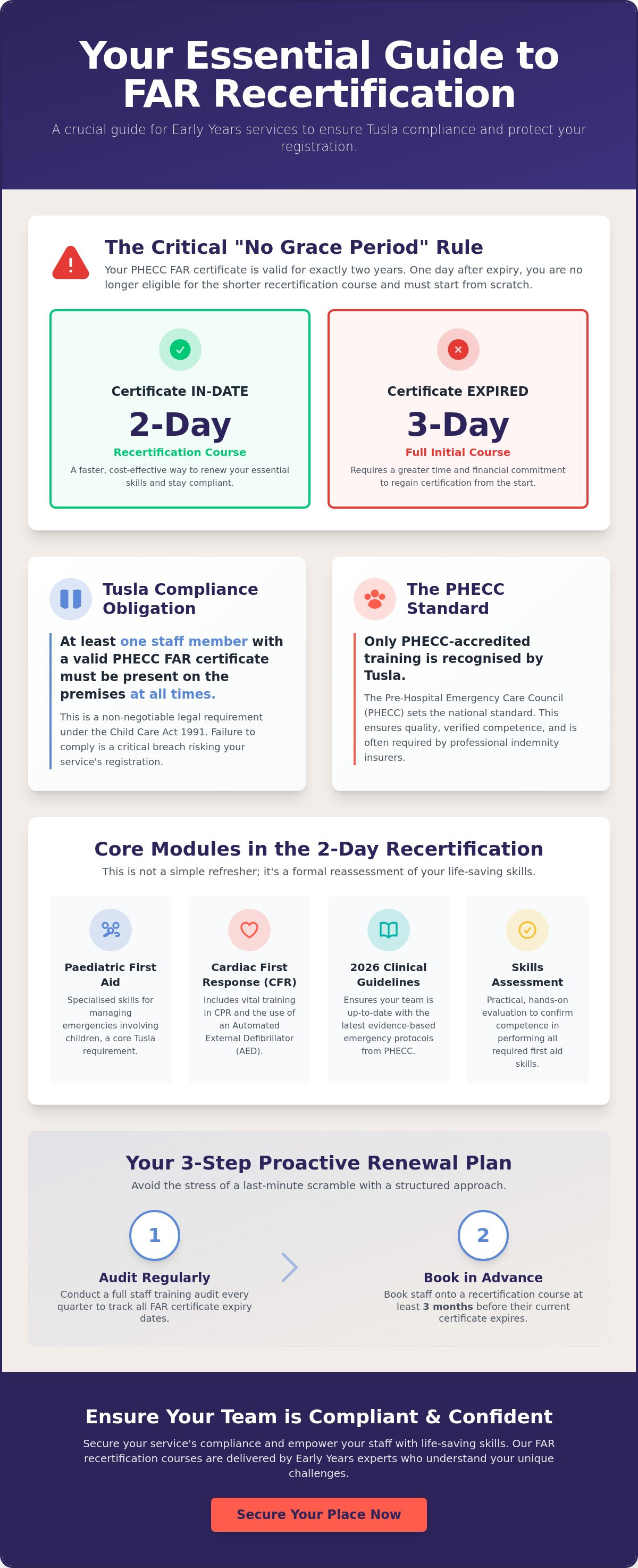
- Learn why the strict "no grace period" rule means you must complete your training before your current certificate expires to avoid a full three-day course.
- Understand your legal obligations under the Child Care Act 1991 to ensure adequate numbers of staff are trained
- Discover how a FAR recertification course Dublin providers trust integrates essential paediatric first aid with Cardiac First Response (CFR) skills.
- Identify the core modules required to maintain your PHECC status and ensure your service remains fully prepared for any emergency scenario.
- Benefit from specialist training delivered by Early Years experts who understand the unique regulatory and practical pressures of the childcare sector.
##Table of Contents
- Understanding FAR Recertification Requirements in Ireland
- Eligibility Criteria: Full FAR Training vs. Recertification
- The Critical Link Between FAR Training and Tusla Compliance
- The 2-Day Recertification Curriculum: Skills and Assessment
- Securing Your Certification with Canavan Byrne
##Understanding FAR Recertification Requirements in Ireland
First Aid Response (FAR) is the statutory standard for workplace first aid in Ireland. It replaced the old FETAC Level 5 Occupational First Aid (OFA) system to provide a more comprehensive framework for emergency care. For anyone in the Early Years sector, this isn't just a recommendation; it's a legal necessity. Tusla specifically recognises FAR as the only valid first aid training for compliance within childcare settings. If you're looking for a FAR recertification course Dublin providers offer, you're likely aware that your current certificate has a strict two-year shelf life.
The transition from Occupational First Aid to FAR was completed in recent years, meaning any remaining OFA certificates are now obsolete. For those in the Early Years sector, the FAR standard is uniquely tailored to include paediatric elements that weren't always a focus in general workplace first aid. This specificity is why Tusla insists on this standard. Proactive planning is essential because the regulatory environment doesn't allow for a "grace period". Once that two-year mark passes, your qualification effectively vanishes. You can't simply take a shorter update course; you'd have to start the full three-day initial training from scratch. This creates a significant administrative and financial burden that most busy childcare managers want to avoid. Maintaining your status through timely recertification ensures your service remains protected and your staff stay sharp.
The Role of the Pre-Hospital Emergency Care Council (PHECC)
The Pre-Hospital Emergency Care Council (PHECC) is the statutory body responsible for setting the national standards for pre-hospital emergency care. Choosing a PHECC-accredited provider is non-negotiable. Without this accreditation, your certificate won't satisfy Tusla inspectors or, crucially, your professional indemnity insurance providers. Most insurers require evidence of current, accredited training to maintain your coverage. It's about more than just a piece of paper; it's about verified competence under a national framework. This level of oversight ensures that every first aider in a childcare setting meets the same rigorous criteria for safety and intervention.
Why "Refresher" is Now "Recertification"
You might hear people use the term "refresher course", but the official term is now "recertification". This shift in vocabulary reflects a more rigorous approach to safety. A recertification isn't a casual review of old notes. It's a formal assessment of a responder's ability to perform life-saving skills to the same high standard as the initial three-day course. When searching for a FAR recertification course Dublin teams can attend, ensure the programme includes the latest 2026 Clinical Practice Guidelines. This ensures your team isn't just "refreshed" but is fully reassessed and competent in modern emergency protocols. It guarantees that the quality of care provided to children remains at the highest possible level.
##Eligibility Criteria: Full FAR Training vs. Recertification
Determining which course your staff member requires is the first step in maintaining your service's safety standards. A FAR recertification course Dublin childcare centres book is specifically designed for those who already hold a valid, in-date PHECC First Aid Response certificate. It's a common misconception that there's a "grace period" following the expiry date on a certificate. In reality, the moment that date passes, the individual is no longer eligible for the shorter two-day programme. This distinction is vital for budget management and staff scheduling, as the full initial training requires a three-day commitment rather than two.
To avoid the logistical headache of a lapsed qualification, we recommend that managers conduct a training audit every quarter. Booking your staff onto a recertification programme at least three months before their current certificate expires provides a necessary safety net. This lead time accounts for unexpected staff illness, centre emergencies, or fully booked training dates. If you're unsure about your team's current status, our team can help you audit your training requirements to ensure you stay ahead of the clock.
Use this simple checklist to review your staff records effectively:
- Verify the certificate is specifically a PHECC First Aid Response (FAR) award, not an older or different standard.
- Identify the exact expiry date, which is precisely two years from the date of issue.
- Confirm the staff member has their original certificate number available for the training provider.
- Check that the staff member's skills haven't faded significantly, as they'll be assessed on day one.
The 30-Day Rule and PHECC Compliance
PHECC guidelines are strict regarding the timelines for renewal. Leaving your booking until the final month of validity is a high-risk strategy that often backfires. If a course is cancelled or a staff member can't attend at the last minute, you may find yourself with a lapsed certificate and a compliance gap. PHECC guidelines dictate that recertification must be completed whilst the original certificate is still in its period of validity. There are no exceptions to this rule, and training providers cannot backdate certifications or "squeeze" candidates in once the deadline has passed.
When to Revert to the Full 3-Day Programme
There are specific scenarios where the two-day recertification isn't an option. If a staff member's certificate has expired by even a single day, they must retake the full First Aid Responder training Ireland standard requires. This often happens with new hires who might've allowed their certifications to lapse between jobs. Managers should always request a copy of a new employee's FAR certificate during the induction phase to catch these issues early. Starting fresh with the three-day course ensures that the responder's knowledge is rebuilt on a solid foundation, meeting the latest 2026 clinical standards.
##The Critical Link Between FAR Training and Tusla Compliance
Regulation 25 of the Child Care Act 1991 (Early Years Services) Regulations 2016 is the definitive legal standard for first aid in Irish childcare. It mandates that every early years service must have a person qualified in First Aid Response available on the premises whenever children are present. This isn't a loose guideline; it's a core condition of your registration. When an inspector arrives, one of the first documents they'll request is your training matrix. If your records show a lapsed qualification, you're facing a non-compliance finding that could have been easily avoided. Securing a FAR recertification course Dublin providers can trust ensures that your staff skills remain sharp and your documentation remains bulletproof.
Lapsed certifications don't just look bad on paper; they represent a genuine risk to the children in your care. An inspector's primary concern is the "Health, Welfare and Development of the Child" pillar of the regulatory framework. If you cannot prove that a qualified responder is present, you're essentially failing in your duty of care. This is why choosing a "tried and tested" training partner is so valuable. You need more than just a certificate; you need the peace of mind that comes from knowing your team can handle a real-world paediatric emergency with cool-headed precision.
Managing Staff Ratios and First Aid Cover
The "at all times" requirement is the most challenging aspect of compliance for many managers. It applies during staff breaks, during morning drop-offs, and whilst on outings. Relying on a single FAR-certified staff member is a high-risk strategy. If that person is sick or delayed, your service is technically in breach of the law. Best practice dictates having at least two or three staff members certified per room or floor. We suggest integrating these training dates into your annual Policies for services review. This proactive approach ensures that cover is never compromised by an expiring certificate or a sudden staff absence.
FAR and the Tusla Quality and Regulatory Framework
The Tusla Quality and Regulatory Framework (QRF) places heavy emphasis on the evidence of staff competence. It's not enough to say your staff are trained; you must hold valid, original certificates on each staff member's file. During our Mock Tusla inspections Ireland services frequently use, we often find that training gaps are the most common source of stress for providers. Identifying these gaps early allows you to book a FAR recertification course Dublin teams can attend before an official inspector arrives. Keeping your files organised and your training current is the simplest way to demonstrate that your service operates with integrity and excellence.
##The 2-Day Recertification Curriculum: Skills and Assessment
The two-day curriculum is a focused, intensive programme designed to strip away introductory theory and prioritise high-stakes application. Unlike generic workplace training that might focus on industrial accidents, a FAR recertification course Dublin providers deliver for the Early Years sector places children at the heart of every scenario. The programme is entirely instructor-led, ensuring that every participant receives direct feedback during "hands-on" practice. You'll move through three core pillars: Patient Assessment, Incident Procedure, and Cardiac First Response (CFR). These modules are updated to reflect the April 2026 PHECC Clinical Practice Guidelines, ensuring your team is practising the most current life-saving techniques.
Maintaining a small instructor-to-student ratio is a hallmark of quality training. In line with national standards, our practical sessions do not exceed a ratio of 1:8. This ensures that every staff member has ample time with the mannequins and receives personalised guidance on their technique. It's this methodical, detail-oriented approach that transforms a mandatory training day into a genuine confidence-building experience for your team. By the end of the 12-hour programme, the goal is for every responder to feel calm and capable, regardless of the emergency they might face.
Paediatric vs. Adult First Aid Nuances
Refreshing your skills in infant and child CPR is a critical component of this course. There are significant physiological differences between treating a toddler and an adult, particularly regarding airway management and the force used during chest compressions. We focus heavily on common childcare emergencies that can escalate in seconds. This includes managing choking incidents, recognising the signs of febrile convulsions, and responding to severe allergic reactions or anaphylaxis. You'll also practice using an Automated External Defibrillator (AED) in a paediatric context. Knowing exactly how to adjust your approach for a child's smaller frame is what builds true confidence in an emergency.
Assessment Day: Demonstrating Competency
The final stage of the course involves a formal assessment of both your practical skills and your theoretical knowledge. Participants must demonstrate proficiency in several key areas:
- Primary and secondary patient assessment.
- Effective CPR and AED use for both adults and children.
- Management of foreign body airway obstructions (choking).
- Wound care, bandaging, and placing a patient correctly in the recovery position.
Following the practical skills test, staff will complete a Multiple Choice Question (MCQ) exam. We understand that exams can be a source of anxiety for some team members. Our instructors adopt a supportive, mentor-like approach, providing plenty of practice time to ensure everyone feels prepared. To secure your team's compliance and sharpen their life-saving skills, you can book your FAR recertification place today with our expert trainers. This structured approach ensures that by the end of day two, every staff member leaves with a renewed sense of readiness and a valid PHECC certificate.
##Securing Your Certification with Canavan Byrne
Choosing a training partner is a strategic decision that impacts the long-term sustainability and safety of your childcare service. With over 25 years of dedicated experience in the Early Years sector, Canavan Byrne understands that first aid is more than a regulatory requirement. It's a fundamental promise of protection you make to every family that enters your centre. When you enrol in a FAR recertification course Dublin providers recommend, you benefit from instructors who don't just teach from a manual; they teach from a deep understanding of the unique pressures and environments of Irish childcare. Our history in the sector allows us to act as a seasoned mentor, guiding you through the complexities of certification with quiet confidence and professional authority.
We believe in a proactive approach to excellence. This means providing training that's both rigorous and accessible, ensuring that your staff aren't just "passing a test" but are truly life-saving ready. By choosing a partner that's "tried and tested" within the industry, you're investing in the reliability and integrity of your own service. Our commitment to high standards mirrors your own, creating a collaborative partnership focused on the safety and welfare of the children in your care. To further professionalise your service and improve how you connect with families, it may also be beneficial to explore E-commerce Web Design options that can help automate your registration and payment systems.
National Training Availability for Early Years Services
We provide comprehensive training solutions for Early Years services across the entire country. We act as a steady hand for managers navigating the often-turbulent waters of Tusla compliance and HSA standards. Finding a FAR recertification course Dublin based or elsewhere is simplified through our streamlined booking system. For larger teams, we offer the flexibility of in-house training sessions, allowing your staff to learn together in the environment where they'll actually apply their skills. Alternatively, our public course bookings provide an efficient option for smaller services or individual staff members needing to renew their status before that critical expiry date.
Beyond Training: A Holistic Compliance Partnership
Take the next step in securing your service's future and maintaining your hard-earned reputation for excellence. Book your Workplace First Aid (FAR) Recertification today and ensure your team is ready for whatever the day brings.
##Maintaining Excellence in Early Years Safety
Staying ahead of regulatory requirements is a hallmark of a high-quality childcare service. By prioritising your staff's training, you ensure that your centre remains fully compliant with Tusla standards whilst building a team that's genuinely ready for any emergency. Remember that the strict "no grace period" rule means proactive scheduling is your best defence against the administrative burden of a lapsed certificate. Completing a FAR recertification course Dublin providers trust allows you to renew these vital skills in just two days, keeping your service operational and your children safe.
As a PHECC Accredited Training Provider with over 25 years of Early Years expertise, we act as a steady hand for your compliance needs. We've earned the trust of thousands of Irish childcare providers by delivering training that understands the specific nuances of the early years environment. Don't wait for an inspection date to discover a training gap. Instead, view recertification as an investment in your team's professional confidence and your service's sustainability.
Secure your staff compliance - Book FAR Recertification
We look forward to supporting your team as they continue to provide the highest standard of care and protection for the children in your community.
##Frequently Asked Questions
How long is the FAR recertification course valid for?
A First Aid Response (FAR) certificate is valid for exactly two years from the date of issue. To maintain your status and avoid a compliance gap, you must complete a two-day recertification course before this expiration date. We recommend booking your FAR recertification course Dublin based place at least three months in advance to ensure you don't miss this critical deadline.
Can I attend a recertification course if my FAR certificate has already expired?
No, you cannot attend the shorter recertification programme if your certificate has already expired by even one day. PHECC rules are absolute on this matter. If your qualification has lapsed, you're required to sit the full three-day First Aid Responder programme again. This is why tracking expiry dates for your entire team is a vital administrative task for any manager.
Is the FAR recertification course recognised by Tusla for childcare workers?
Yes, the FAR recertification course is the only first aid standard currently recognised by Tusla for the Early Years sector. Under the Child Care Act 1991 (Early Years Services) Regulations 2016, services must have at least one person with this specific PHECC qualification on-site at all times. Generic first aid certificates simply don't meet these legal requirements for compliance.
What happens if I lose my original PHECC FAR certificate before the course?
You must have your original certificate number to enrol in a recertification programme. If you've misplaced the physical document, contact your original training provider immediately to request a duplicate or a verified record of your certification. Our instructors require this information to register your new award with PHECC once the course is complete.
Do I need to bring anything specific to the 2-day training programme?
Participants should wear comfortable, practical clothing as the course involves significant floor-based work, such as CPR and recovery position practice. You'll also need to bring your existing PHECC certificate number and a form of photo identification. We provide all necessary training materials and mannequins, so you only need to bring a readiness to learn and practice.
How many staff members in a creche need to have a FAR certificate?
Tusla requires that there are adequate numbers of staff with a valid FAR certificate is on the premises at all times when children are present. This means at least one at any time. In practice, this means most creches need multiple certified staff members to cover lunch breaks, staff sickness, and outings. Having a higher ratio of trained responders is considered best practice for child safety and service resilience.
What is the difference between Paediatric First Aid and FAR recertification?
FAR is a comprehensive national standard that includes Cardiac First Response (CFR) and both adult and paediatric care, whereas generic Paediatric First Aid often lacks PHECC accreditation. While paediatric-only courses are useful for parents, they don't satisfy the legal workplace requirements for Irish childcare providers. A FAR recertification course Dublin childcare staff attend ensures full compliance with both HSA and Tusla regulations.


